Introduction
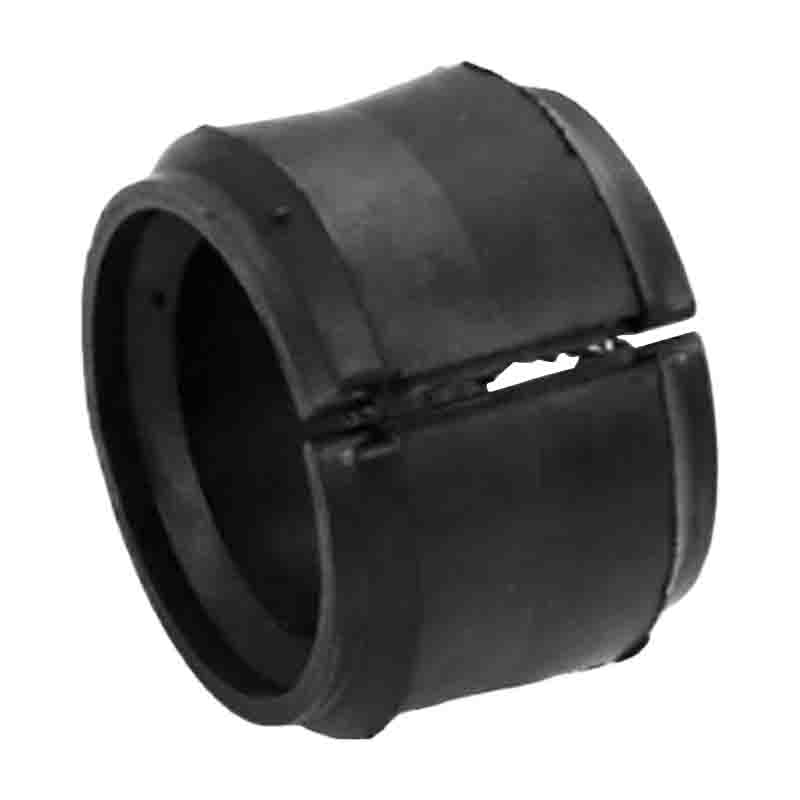
The DAF stabiliser bush (OE 0558864) is the least visible link in the roll-control chain on a fully loaded 40-tonne XF tractor unit — and usually the first one to fail. Clamped between the anti-roll bar and its saddle bracket, it converts the height difference across the axle into a torsional reaction that keeps the vehicle flat through corners and lane changes. Once the rubber wears, cracks or is attacked by oil, the bar starts to move axially inside the saddle: the cab picks up a metallic knock, the steering goes vague, and the front tyres begin to feather.
This single size covers the great majority of DAF chassis built between the 1970s F series and the 2021 model-year XF, CF and LF — which makes it one of the highest-volume anti-roll bar bushes in the European truck aftermarket. Buyers in North America may know the same component as a sway bar bushing or stabilizer bushing; the part is identical.
This guide covers construction, compound, cross-references, vehicle fitment, failure diagnosis and installation torque, for fleet workshops, factors and OEM tier suppliers across Europe.
It is published by Hebei Tongsource International Trade Co., Ltd., the wholly-owned export subsidiary of Hebei Huami New Material Technology Co., Ltd. (listed on the Beijing Stock Exchange, stock code 920247), which handles worldwide export of Huami's rubber damping, sealing and engineering plastic components.
1. How to confirm you need this part — three checks
1. Measure the bore of the removed bush, or the bar diameter itself. It must be 57 mm. DAF uses Ø50, Ø57 and Ø60 anti-roll bars across the same model ranges depending on suspension specification and build plant.
2. Check the model and year against the fitment table in section 3. Note that the New Generation DAF XD / XF / XG (2021 onward) uses a different chassis architecture — do not assume carry-over.
3. Cross the old part number against section 4. If your existing stock is febi 19313, DT 5.13116, SAMPA 050.025, MEYLE 14-36 010 0014 or MOOG DF-SB-5253, this part is a direct substitute.
If any of the three does not line up, send us a photo and the chassis number and we will identify the correct part instead of shipping the wrong one.
2. Technical detail: construction, compound and performance
2.1 What the bush actually does
An anti-roll bar is, in essence, a transverse torsion bar. In a corner the outer suspension compresses while the inner extends; the bar twists and generates a restoring moment that limits body roll. For this to work, the bar must rotate freely inside its saddle while being held firmly in every other direction. That is the job of 0558864: radial stiffness, low torsional friction, and vibration and noise isolation in all directions.
DAF presses the bush into a U-shaped saddle bracket, which is bolted to the chassis rail or axle bracket with two M12 or M14 fasteners. The bush therefore carries three load types at once: high-frequency road input, steady-state radial compression in cornering, and axial shear under braking and acceleration.
2.2 Compound: why any black rubber will not do
0558864 is built on a natural rubber base modified with a small proportion of SBR. NR is chosen for its dynamic behaviour: high resilience, low heat build-up, excellent tear and fatigue resistance — precisely what a bush needs when it cycles tens of thousands of times per hour at small amplitude. Pure SBR or reclaimed-rubber compounds are cheaper, but they run hot and take a permanent set; within three to five months in service they collapse and open up clearance around the bar.
• Anti-degradant system: microcrystalline wax with PPD-type antiozonants, resisting UV and ozone attack at high European latitudes (ISO 1431-1: 50 pphm / 40 °C / 72 h, no cracking).
• Reinforcement: N330 / N550 carbon black blend, balancing modulus against abrasion resistance.
• Cure system: semi-efficient vulcanisation for hardness stability after heat ageing — no more than +8 Shore A after 168 h at 70 °C.
• Hardness: 65 ± 5 Shore A as standard. For operators running Alpine or Pyrenean routes, quarry work or heavy container haulage, a 70 ± 5 Shore A version raises radial stiffness noticeably at a small cost in ride comfort.
2.3 Design details
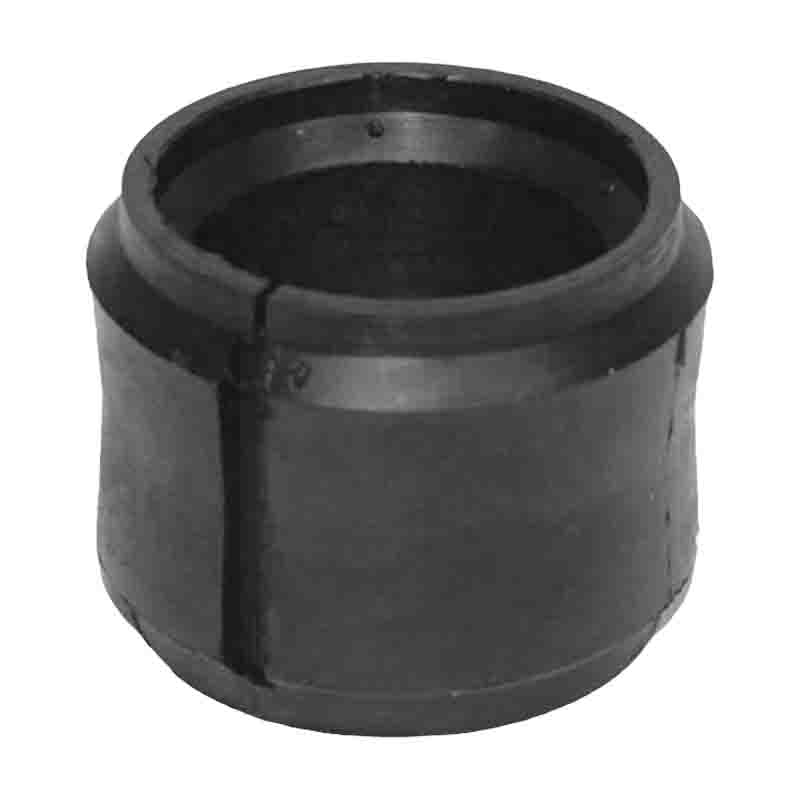
This is a one-piece rubber bush with no inner metal sleeve — several brands catalogue it as a "stabiliser mounting". The Ø57 mm bore grips the bar directly; the Ø85 mm outer surface is an interference fit in the saddle. Three design points matter:
1. Bore surface. Huami's tooling incorporates micro grease-retention grooving; combined with a silicone assembly paste this markedly reduces early dry-friction squeal.
2. Interference allowance. Designed at 0.6–1.0 mm so the bush cannot spin in the saddle. Too little and it rotates and wears; too much and assembly becomes difficult while pre-stress concentrates locally.
3. End-face radii. R2 transitions at both ends prevent the stress concentration that starts end-face cracking — the usual failure origin on low-cost copies.
3. Vehicle application list
Compiled from the official fitment scope of DAF OE 0558864. Always confirm against the chassis number (VIN) or by measuring the removed part before ordering.
Model | Year | Fitting position | Notes |
DAF XF / XF 105 | 2002 – 2021 | Front / rear anti-roll bar | FT, FTG, FTP, FAN chassis |
DAF 95 XF | 1997 – 2002 | Front / rear anti-roll bar | XF 315M / 355M / 380 / 430 / 480 / 530 |
DAF 95 | 1987 – 1998 | Front / rear anti-roll bar | 95.310 / 95.350 / 95.400 |
DAF CF 65 / CF 75 / CF 85 | 2001 – 2021 | Front / rear anti-roll bar | Full CF range |
DAF 85 / 85 CF | 1992 – 2000 | Front / rear anti-roll bar | 85.330 / 85.360 / 85.400 |
DAF 75 / 75 CF | 1992 – 2001 | Front / rear anti-roll bar | 75.240 / 75.270 / 75.310 |
DAF 65 / 65 CF | 1993 – 2000 | Front / rear anti-roll bar | 65.180 / 65.210 / 65.240 |
DAF LF / LF 45 / LF 55 | 2013 – 2021 | Front anti-roll bar | Leyland-built; verify bar Ø by chassis |
DAF F 1900 | 1986 – 1993 | Front anti-roll bar | Classic F series |
DAF F 2300 | 1978 – 1993 | Front anti-roll bar | Classic F series |
DAF F 2700 | 1990 – 1993 | Front anti-roll bar | Classic F series |
DAF F 2800 | 1974 – 1991 | Front anti-roll bar | Classic F series |
DAF F 2900 | 1986 – 1993 | Front anti-roll bar | Classic F series |
DAF F 3200 | 1990 – 1993 | Front anti-roll bar | Classic F series |
DAF F 3300 | 1981 – 1991 | Front anti-roll bar | Classic F series |
DAF F 3600 | 1985 – 1991 | Front anti-roll bar | Classic F series |
DAF SB / VDL bus chassis | 1985 – present | Front anti-roll bar | Selected batches — verify on vehicle |
VOLVO (shared size) | By chassis no. | Anti-roll bar | Some platforms share Ø57 bar |
Note on Leyland-built vehicles: LF and some CF variants assembled at DAF's Leyland plant in Lancashire can carry different suspension specifications from Eindhoven-built units of the same model year. UK operators should measure rather than order from the model designation alone.
4. Cross-reference numbers
The following numbers are interchangeable with DAF 0558864 in the European aftermarket and can be used directly for TecDoc lookup, ERP part-master creation and RFQ comparison.
Brand | Part number |
DAF (OE) | 0558864 / 558 864 |
febi bilstein | 19313 |
DT Spare Parts | 5.13116 |
SAMPA | 050.025 |
MEYLE | 14-36 010 0014 |
MONROE | L90L03 |
MOOG | DF-SB-5253 |
SKF | VKDCV 09041 |
RUVILLE | 986301 |
SWAG | 59 91 9313 |
S-TR | STR-120855 |
PE Automotive | 103.065-00A |
AUGER | 51849 |
OCAP | 1216313 |
STELLOX | 84-08121-SX |
Vibracoustic | VCAMMTC003 |
REINHOCH | RH58-8002 |
APlus | 22654AP |
AYD OE-Excellence | 72-11543 |
Automotive RYME | 322012 |
CASALS | 7453 |
CUYMAR | 4703864 |
HD | HD 10033 |
SEM LASTIK | 7728 |
ST-TEMPLIN | 04.120.0282.170 |
TIGRIL | DA08.0012 |
Wti Automotive | A881380 |
This bush is a direct replacement for febi bilstein 19313, DT Spare Parts 5.13116 and SAMPA 050.025. Workshops currently stocking MEYLE 14-36 010 0014, MOOG DF-SB-5253, SKF VKDCV 09041 or MONROE L90L03 can cross to this part with no modification to the saddle or bar. Distributors running PE Automotive 103.065-00A, S-TR STR-120855 or AUGER 51849 in their catalogues will find the same interface dimensions here. Where an existing supplier has discontinued a line — RUVILLE 986301 is no longer produced, for example — this part fills the gap without a catalogue change.
All trademarks and part numbers are the property of their respective owners and are quoted solely to identify interchangeability. Huami / Tongsource is an independent manufacturer; these are not original equipment parts.
5. Typical failure symptoms
Anti-roll bar bushes fail progressively. Symptoms escalate roughly in this order:
1. A repeated metallic knock from the front axle over speed humps or potholes — the bush has worn thin and the bar is striking the saddle.
2. Noticeably increased body roll in low-speed turns and lane changes; drivers report the truck feeling loose and the steering vague.
3. Visible network cracking or longitudinal tearing on the rubber, or rubber extruded past the edge of the saddle.
4. Swelling and softening after contamination by engine oil, diesel or hydraulic fluid, with a sharp drop in hardness.
5. A polished wear ring on the bar itself at the bush location, showing the bush has been slipping on the bar.
6. Feathered or uneven inner/outer front tyre wear — left unaddressed this can cut tyre life by 30–40 %.
7. Saddle bolts repeatedly loosening or breaking, because a collapsed bush loses clamp load and the bolts take alternating shear.
8. Noise that is loud on a cold winter start and fades after around 20 minutes — low-temperature stiffening combined with wear clearance. Common on Scandinavian and Baltic operations.
Recommended inspection interval: every 150,000–200,000 km or 24 months for general highway haulage; every 80,000–120,000 km for construction, tipper and container shuttle duty where roll cycles are frequent.
6. Key specification table
Parameter | Value | Tolerance | Remark |
Inner diameter (I.D.) | 57 mm | ±0.5 mm | Matches DAF Ø57 anti-roll bar |
Outer diameter (O.D.) | 85 mm | ±0.6 mm | Interference fit in the saddle bore |
Height / length (H) | 60.5 – 61 mm | ±0.5 mm | Interchangeable within tolerance band |
Wall thickness | 14 mm nominal | — | (85 − 57) / 2 |
Base polymer | Natural rubber NR / NR-SBR blend | — | High resilience, low heat build-up |
Shore hardness | 65 ± 5 Shore A (standard) | ±5 | Heavy-duty option 70 ± 5 Shore A |
Tensile strength | ≥ 15 MPa | — | ISO 37 |
Elongation at break | ≥ 350 % | — | ISO 37 |
Compression set | ≤ 25 % (70 °C × 22 h) | — | ISO 815 |
Tear strength | ≥ 30 kN/m | — | ISO 34-1 |
Ozone resistance | 50 pphm / 40 °C / 72 h, no cracking | — | ISO 1431-1 |
Hardness change after ageing | ≤ +8 Shore A (70 °C × 168 h) | — | ISO 188 |
Operating temperature | −40 °C to +80 °C (peak +100 °C) | — | Nordic winter to southern-EU summer |
Radial static stiffness | Design target — rig report on request | — | Tunable to customer curve |
Fatigue durability | Rig-validated — report on request | — | Cyclic radial displacement test |
Net weight per piece | approx. 0.40 kg | ±5 % | 407 g measured reference |
Colour / finish | Black, flash-free, fully cured | — | Automatic de-flashing after moulding |
Fitting position | Front / rear anti-roll bar | — | Common front and rear |
REACH compliance | SVHC declaration available | — | EC 1907/2006 |
HS / commodity code | 4016 9990 | — | EU import declaration |
Packing | Neutral poly bag + 5-ply export carton | — | Private-label packing available |
7. Installation notes
1. Replace in pairs. Both bushes on the same bar must be changed together; asymmetric stiffness causes pull and one-sided tyre wear.
2. Clean the saddle first. Wire-brush all rust and old rubber residue out of the saddle bore — scale materially changes the effective interference.
3. Use silicone lubricant only. Assemble with silicone grease or a dedicated rubber assembly paste. Never use chassis grease, engine oil, detergent or soapy water; mineral oil swells and destroys NR rubber.
4. Inspect the bar. If it shows a groove or polished ring at the bush seat, replace the bar as well, otherwise the new bush will wear out within a few thousand kilometres.
5. Torque at ride height. Tighten the saddle bolts only with the wheels on the ground and the suspension at design load. Torquing on a lift locks the rubber in a pre-twisted state — the single most common life-shortening error.
6. Observe torque values. M12 bolts typically 80–100 N·m, M14 typically 130–160 N·m; always confirm against the DAF workshop manual for the specific model. Over-tightening extrudes the rubber; under-tightening creates impact loading.
7. Renew fasteners. Self-locking nuts and lock plates should be replaced along with the bushes.
8. Re-check torque after 500–1,000 km of service.
9. Storage. Keep rubber parts away from light and ozone sources such as electric motors and welding equipment, at 5–30 °C, and use within 24 months.
8. Frequently asked questions
Q1: Are 0558864 and 558 864 the same part number?
Yes. DAF documents the same number with and without the leading zero across different systems; the part is identical. Either format works for searching or ordering.
Q2: Can the same bush be used on the front and rear axle?
For this size, DAF fitment data shows it is common to front and rear. Even so, measure the bore of the removed part — some CF and XF specifications use different bar diameters front to rear.
Q3: Does it fit the New Generation DAF XD, XF and XG?
Not assumed. The 2021-onward New Generation range uses a revised chassis and suspension architecture. Send us the chassis number and we will confirm the correct reference rather than guess.
Q4: How does your part differ from febi 19313 or DT 5.13116?
Dimensions and mounting interface are identical and directly interchangeable. The difference is that we supply from the factory: our own tooling, our own compound, no intermediate brand premium, plus the option to specify hardness (65 or 70 Shore A) and packaging.
Q5: Should I choose 65 or 70 Shore A?
65 Shore A for general long-haul work — closest to OE calibration and the best balance of comfort and life. 70 Shore A for Alpine routes, quarry and tipper work, or duty cycles with frequent hard cornering: more radial stiffness and better resistance to collapse.
Q6: What is the MOQ and the sample lead time?
For items with existing tooling, MOQ is typically 200–500 pieces and orders can be consolidated into one container. Free samples of 3–5 pieces ship within 3–7 working days. New tooling takes 20–30 days.
Q7: Do you supply private-label packaging for factors and distributors?
Yes. Neutral packing, customer-branded colour boxes, EAN barcode labels and multilingual instruction cards are all available, as is laser marking or in-mould engraving of your own part number.
Q8: How is EU compliance handled — REACH, and UKCA for the UK?
A REACH SVHC declaration under EC 1907/2006 is issued with each shipment, together with a material composition report. For UK imports we supply the commodity code, preferential-origin documentation where applicable, and support your customs agent with the post-Brexit declaration set. Huami holds IATF 16949, ISO 9001, ISO 14001, ISO 45001 and TÜV certification; Tongsource holds AEO Advanced Certification status.
Q9: What are the lead times and shipping routes into Europe?
Standard items are ready 7–15 days after order confirmation. Sea freight runs roughly 30–35 days to Rotterdam, Antwerp and Hamburg, and to Felixstowe or Southampton for the UK; Gdansk serves Poland and the Baltic. Air freight is 5–8 days and small quantities can go by DHL or FedEx. DDP to door is available, as is stocking in a European warehouse for phased release.
Q10: How can I verify batch-to-batch consistency?
Every batch ships with a certificate of conformity recording measured hardness, dimensions and visual inspection. Third-party inspection (SGS, BV or TÜV) can be nominated; scope and cost are agreed in advance.
Q11: Can you develop new items from my sample or drawing?
Yes — this is one of our core capabilities. Send a physical sample, a 3D model or a 2D drawing to start reverse engineering; where required we validate the stiffness curve on a test rig before releasing the design.
9. Summary and next step
The 0558864 stabiliser bush is a low-value item that carries high consequences: it governs roll control, tyre life and driving safety. Specifying the wrong hardness, or buying a reclaimed-rubber compound, typically costs many times the price of the part in tyres and downtime.
Hebei Huami New Material Technology Co., Ltd. (Beijing Stock Exchange, code 920247) has years of depth in rubber damping and sealing components, with a complete chain from compound design and tooling manufacture through to finished-part testing. Its wholly-owned subsidiary, Hebei Tongsource International Trade Co., Ltd., handles worldwide export, holds AEO Advanced Certification, and supplies OEM tier suppliers and aftermarket distributors across Europe.
Available on request: free samples · factory price list · material and dimensional reports · complete DAF anti-roll bar bush catalogue.
Send us your part number list, annual volume and destination port — we reply with a formal quotation within 24 hours.


