1. Introduction: The Most Underrated Load-Bearing Part in the Rear Suspension
When a heavy truck rear suspension is discussed, attention usually goes to the leaf springs and the shock absorbers. Yet the component that quietly decides both unladen ride comfort and laden stability is a block of rubber: the Volvo leaf spring rubber mounting, OEM number 20390836.
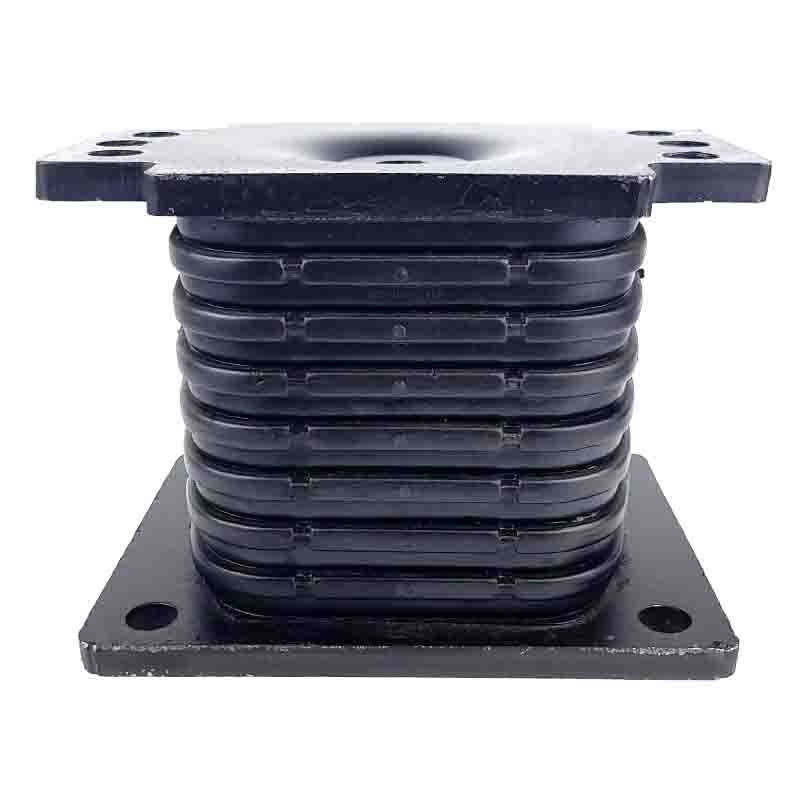
This hollow rubber spring sits between the rear leaf (parabolic) spring assembly and the frame bracket. Unladen, its low initial rate absorbs high-frequency road inputs. As load builds, the internal cavity progressively compacts and the rate rises non-linearly, producing a progressive load curve. That is why a Volvo FH12 can run empty and at 40 tonnes GCW while keeping acceptable chassis attitude and cab vibration in both states.
For European and North American fleets and parts wholesalers, 20390836 is a classic high-rotation wear item: meaningful unit value, a predictable replacement interval, and very broad coverage across Volvo FH, FM, FMX, FL, FE and Renault Premium, Kerax and C/D/K ranges. Supplier choice directly affects warranty rates and stock turnover.
This article was prepared by the technical team of Hebei Tongsource International Trade Co., Ltd., a wholly-owned subsidiary of Hebei Huami New Material Technology Co., Ltd., a rubber damping, sealing and engineering plastics manufacturer listed on the Beijing Stock Exchange.
2. Technical Deep Dive: Construction, Materials and Performance
2.1 Function and Working Principle
Part 20390836 appears under several names across catalogues, which is a frequent source of sourcing errors. Aligning the terminology first:
• Volvo OE: Rubber Spring / Rear Suspension Load Spring
• European aftermarket (Febi, Monroe, PE): Bush, Parabolic Spring
• Sampa, Lemförder, Auger: Mounting, Leaf Spring
• Common trade terms: hollow rubber spring, leaf spring rubber pad, spring cushion
It is a combined load-bearing and damping element used in Volvo rear suspensions, including RADD-TR1 / RADD-TR2 configurations, and performs three jobs:
1. Progressive load support — the hollow geometry produces a rising, non-linear spring rate, balancing unladen comfort against laden support.
2. Vibration and noise isolation — rubber damping attenuates high-frequency road input and structure-borne noise, protecting cab NVH.
3. Travel limiting and impact absorption — it acts as a bump stop at maximum articulation, protecting the spring root, bracket and frame riveted zone.
2.2 Construction
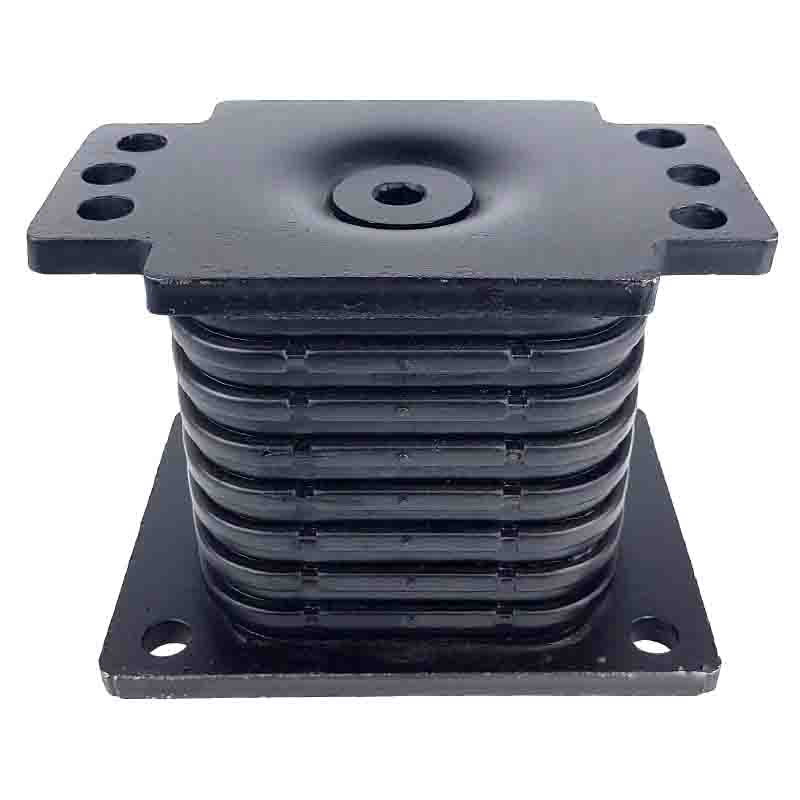
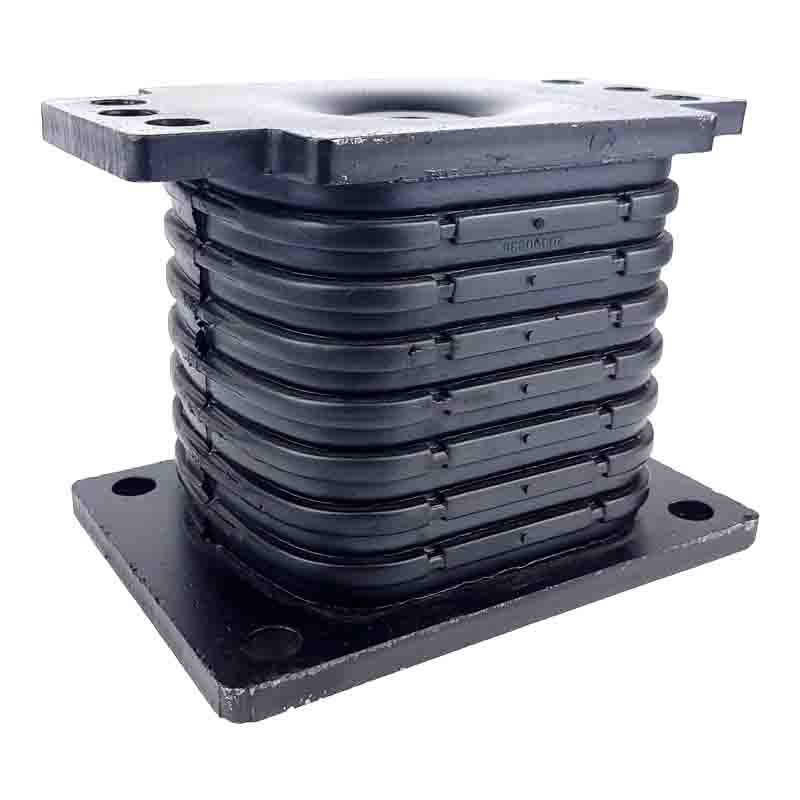
• Upper mounting plate: cold-stamped steel with locating and bolt holes, seating against the frame bracket.
• Hollow rubber body: barrel-shaped outer profile with an internal cavity; cavity geometry defines the progressive rate curve and reduces heat build-up per unit volume.
• Lower seat plate / insert: the leaf-spring contact face, carrying combined compression and shear loading.
• Single-shot vulcanisation: rubber and metal are bonded under pressure in one mould, using a two-coat (primer + cover coat) adhesive system to prevent later delamination.
2.3 Materials and Compound
The load-bearing body uses an NR / SBR blend with a high polymer content, balancing three properties that normally trade off against each other:
• High resilience and low heat build-up — natural rubber gives excellent rebound and fatigue life under long-term alternating load.
• Abrasion and ageing resistance — SBR improves wear resistance and thermal-oxidative stability.
• Weather and ozone resistance — a 6PPD/IPPD antiozonant package combined with microcrystalline wax handles European winter road salt and UV exposure.
Inserts are Q235B / S235JR cold-rolled steel, phosphated and cathodic e-coated (or epoxy powder coated), tested to at least 480 hours neutral salt spray for Nordic and Canadian salt environments.
The compound is mixed in-house by the parent company, Hebei Huami New Material Technology Co., Ltd. As a listed rubber material producer, Huami can adjust the formulation to the customer market and duty cycle — Middle East heat, Nordic cold, South American overload — which a pure trading company cannot offer.
2.4 Note on Cross OEM Numbers
Volvo has released this part under several material numbers across plants and model years; they are functionally interchangeable: 20390836, 1629553, 1622982, 1609657, 1577873, 1089501 and 8151413. Renault Trucks uses the same part under 74 20 390 836 (written 7420390836).
Always verify against the physical dimensions of 210 x 148.4 x 134.4 mm and the free height, because some older F10 / F12 applications use a visually similar but shorter rubber seat that is not interchangeable.
3. Vehicle Application List (by Model and Year)
Make | Model | Years | Notes |
VOLVO | FH / FH12 / FH16 | 1993 – present | Long-haul tractor & heavy vocational, core application |
VOLVO | FM / FM7 / FM9 / FM10 / FM12 | 1998 – 2008 and current | Regional distribution and construction |
VOLVO | FMX | 2010 – present | Construction, tipper, severe duty |
VOLVO | FL / FL6 / FL7 / FL10 / FL12 | 1985 – 1998 (older); 2000 – present (current FL) | Medium / heavy distribution |
VOLVO | FE | 2006 – present | Urban distribution, municipal |
VOLVO | NH12 | 1997 – present | Export markets (NA / Oceania) |
VOLVO | F10 / F12 / F16 | 1976 – 1995 | Classic models, steady aftermarket demand |
RENAULT TRUCKS | PREMIUM / Premium 2 | 2005 – present | Shared platform with Volvo, common part |
RENAULT TRUCKS | KERAX | 2005 – present | Heavy construction |
RENAULT TRUCKS | C / D / K Series | 2013 – present | New generation platform |
Note: Volvo FH / FM platforms carry many suspension configurations, and the same model may use different rubber seats depending on the rear suspension code (RADD-TR1, RADD-TR2, RAD-A, etc.). Send us the VIN or chassis number and we will verify the fit free of charge.
4. Cross-Reference Table
Brand | Part Number |
VOLVO (OE) | 20390836 / 1089501 / 1577873 / 1609657 / 1622982 / 1629553 / 8151413 |
RENAULT TRUCKS (OE) | 74 20 390 836 / 7420390836 |
FEBI BILSTEIN | 03528 |
SAMPA | 030.076 / 030.078 |
LEMFÖRDER | 25563 01 |
SKF | VKDCV 01044 |
MONROE | L97L21 |
MOOG | VL-SB-5356 |
DT SPARE PARTS | 2.62045 |
PE AUTOMOTIVE | 144.034-00A / 144.039-00A |
TRUCKTEC AUTOMOTIVE | 03.30.014 |
AUGER | 51663 / 51665 |
C.E.I. | 198.766 |
CAUTEX | 776536 |
METALCAUCHO | 54513 |
STELLOX | 84-43301-SX / 84-43308-SX |
OE GERMANY | 800536 |
OCAP | 1249735 |
OREX | 332004 |
ADR | 54579967 |
APlus / UPG | 22537AP |
ASPART | 1LSR1003 |
AYD OE-Excellence | 76-11426 |
Automotive RYME | 322008 |
CASALS | 6745 7384 |
CPB | 504604 |
CUYMAR | 2512553 |
DSS | 207154 |
EAP | EAP01887 |
ELPI | LP205 3432 |
ETG Automotive | 02.03.32.216826 |
FARE SA | 37464 |
GERMO | VM60011 |
HD | HD 14002 / HD 19101 |
KM Germany | 027 0070 |
KTK GERMANY | 7877 |
PLYOM | P776536 |
ROTA | 2077217 |
SCHNIEDER AUTOTECH | VLT35.00025 |
SEM LASTIK | 8333 / 8403 |
SRP | 90836-BP / 29553-BP / 22982-BP |
ST-TEMPLIN | 04.190.4001.020 |
STC | T454513 |
TIGRIL | VO09.0002 |
WTI Automotive | A881035 / T048072 |
YUMAK | 123.01.025 |
4U Autoparts | 28036VO |
Cross-reference numbers are listed for identification and matching purposes only. All brands and numbers remain the property of their respective owners. Our products are aftermarket replacement parts and are not original equipment.
5. Typical Failure Symptoms
Failure is usually progressive, and early symptoms are often misdiagnosed as a shock absorber or leaf spring fault. These eight are the most commonly reported by European workshops:
1. Rear ride-height sag or side-to-side difference — unladen frame height below specification, or more than about 10 mm difference across the same axle, indicating permanent set in the rubber.
2. Metallic clunk over bumps — the rubber has run out of compression travel and the steel seat contacts the spring or bracket directly.
3. Surface crazing or longitudinal tearing of the rubber — ozone and thermal-oxidative ageing, typical on vehicles over five years old or in sustained high-temperature duty.
4. Visible separation at the rubber-to-metal interface — bond failure; this is a safety issue requiring immediate replacement.
5. Rubber extruded or bulging outward — chronic overload or excessive compression set in the compound.
6. Abnormal tyre wear (inner edge or stepped wear) — a collapsed mounting has altered rear axle geometry.
7. Increased body roll and vague handling when laden — reduced lateral stiffness.
8. Noticeably higher cab and body vibration and noise — lost damping capacity transmits high-frequency input straight into the frame.
Recommendation: fleets should add this to routine inspection at 200,000 km or 3 years, whichever comes first; reduce to 120,000 km for tipper, construction and off-highway duty.
6. Key Specification Table (Hardness, Dimensions, Materials)
Item | Specification | Remark / Test Standard |
Product name | Rear leaf spring rubber mounting (hollow rubber spring) | a.k.a. Bush, parabolic spring |
OEM number | 20390836 | Renault Trucks: 7420390836 |
Fitting position | Rear suspension, between leaf/parabolic spring and frame bracket | Left / right interchangeable |
Length L | 210 mm | Replicated from OE |
Width W | 134.4 mm | Replicated from OE |
Height / thickness H | 148.4 mm | Free height |
Unit weight | 9.6 – 9.7 kg | Including steel inserts |
Rubber compound | NR / SBR blend, high polymer-content formulation | Compound produced in-house by Huami |
Rubber hardness | Shore A 62 ± 5 (load-bearing body) | ISO 7619-1 |
Tensile strength | ≥ 16 MPa | ISO 37 |
Elongation at break | ≥ 400 % | ISO 37 |
Tear strength | ≥ 35 kN/m | ISO 34-1 |
Compression set | ≤ 25 % (70 °C × 24 h) | ISO 815 |
Heat ageing | Hardness change ≤ +8 Shore A (70 °C × 72 h) | ISO 188 |
Ozone resistance | 50 pphm, 40 °C, 20 % strain, 96 h — no cracking | ISO 1431-1 |
Rubber-to-metal bond | ≥ 8 N/mm, cohesive failure in rubber | ASTM D429 Method B |
Insert material | Q235B / S235JR cold-stamped steel | Thickness per drawing |
Surface treatment | Phosphating + cathodic e-coat (or epoxy powder) | Neutral salt spray ≥ 480 h |
Service temperature | -40 °C to +80 °C | Short term up to +100 °C |
Bench fatigue life | ≥ 1,000,000 cycles at ±10 mm displacement, no cracking or debonding | Internal bench specification |
Quality system | IATF 16949 / ISO 9001 | Parent company listed on Beijing Stock Exchange |
Note: the table gives typical specifications for our standard part. Final values are governed by the drawing and technical agreement agreed between both parties. Hardness and rate curve can be customised to the customer duty cycle.
7. Installation Notes
1. Replace in pairs. Both sides of the same axle must be changed together. Replacing one side creates asymmetric stiffness, causing pulling and uneven tyre wear.
2. Lift and support correctly. Use compliant lifting equipment and axle stands, and fully unload the rear axle before removal. Never work on a jack alone.
3. Clean the mating faces. Remove corrosion, old rubber residue and grit from the bracket and spring contact faces. Burrs and rust nodules create stress concentrations that crack a new part early.
4. Inspect related parts. Check U-bolts, spring leaves, bracket bushes and shock absorbers at the same time, so a failing neighbour does not destroy the new mounting.
5. Bolts and torque. Always fit new U-bolts and new self-locking nuts, and tighten diagonally in two or three stages to the torque specified in the Volvo workshop manual. Never estimate torque by feel.
6. Final torque under load. Complete final tightening with the vehicle on the ground and the rear axle carrying kerb load, so the rubber sits at its normal pre-compressed position. Tightening unloaded induces initial torsional stress.
7. No oil, grease or solvents. Do not apply mineral-oil-based lubricants to the mounting faces; NR/SBR compounds swell and fail on contact with mineral oil. Clean water or a neutral soap solution may be used to aid positioning.
8. No flame, no prying on the rubber. Never heat the part with a torch, and never lever directly against the rubber body — internal damage is invisible but permanent.
9. Re-check after bedding in. Re-torque the bolts after 500 – 1,000 km and carry out a rear axle / wheel alignment check.
8. Frequently Asked Questions
Q1. Are 20390836, 1629553 and 7420390836 the same part?
A. Yes. They are the same functional part under different Volvo material numbers and the Renault Trucks system. Other interchangeable Volvo numbers are 1089501, 1577873, 1609657, 1622982 and 8151413.
Q2. Is your part interchangeable with Febi 03528 and Sampa 030.076?
A. Yes. Those are major European aftermarket products developed for the same OE position, with the same dimensions and mounting interface. Our part is built to OE dimensions and replaces them directly.
Q3. Is harder rubber always more durable?
A. No. Excessive hardness sacrifices damping and fatigue life, raising frame stress and cab vibration; too soft and the part sags under load. We use a balanced Shore A 62 ± 5 setting and can adjust it to the customer actual load case.
Q4. What is the replacement interval?
A. For normal on-highway duty we recommend inspection at 200,000 km or 3 years and replacement based on condition. For tipper, mining and rough-road duty, reduce to around 120,000 km. Real service life depends heavily on load, road surface and temperature.
Q5. Can I replace only one side to save cost?
A. We strongly advise against it. A single-side replacement creates a stiffness imbalance that leads to body lean, pulling and uneven tyre wear, and ends up costing more.
Q6. How do I confirm the correct part for my vehicle?
A. The most reliable route is to send the VIN or chassis number so we can verify the rear suspension code and the original material number. Alternatively, measure the length, width, free height and hole spacing of the old part and send them to us for comparison.
Q7. Are you a factory or a trading company?
A. Hebei Tongsource International Trade Co., Ltd. is a wholly-owned subsidiary of Hebei Huami New Material Technology Co., Ltd., which is listed on the Beijing Stock Exchange. Parts are produced in the parent company factory with compound mixed in-house, backed by full R&D, tooling and testing capability.
Q8. What are your MOQ, sample policy and lead time?
A. Trial quantities are accepted on standard running items and samples can be supplied. Bulk lead time is typically 25 – 35 days after deposit, confirmed per order. We ship FCL, LCL and by air.
Q9. Can you supply under our own brand (OEM / private label)?
A. Yes. We support customer logo, colour box, barcode and EAN coding, product information cards, and marking to your own catalogue number.
Q10. How is batch-to-batch consistency ensured?
A. We operate to IATF 16949. Every compound batch is checked by rheometer (MDR) against the reference cure curve, finished parts are sampled for hardness, dimensions and bond strength, and traceable batch records are retained.
9. About Hebei Tongsource International Trade Co., Ltd.
Hebei Tongsource International Trade Co., Ltd. is a wholly-owned subsidiary of Hebei Huami New Material Technology Co., Ltd. Huami is a manufacturer of rubber damping, sealing and engineering plastic components listed on the Beijing Stock Exchange, with integrated capability from compound formulation and mould design through to production and testing.
As the group export platform, Tongsource serves OEMs, wholesalers, fleets and repair chains across Europe and North America with custom development, volume supply and after-sales technical support for commercial vehicle rubber damping and sealing parts.
10. Summary and Next Step
The Volvo 20390836 leaf spring rubber mounting looks simple, but it is a load-bearing part with real requirements on compound formulation, bonding process and rate curve. Price differences usually reflect polymer content, antioxidant package and bonding quality — the very factors a fleet only feels two years later.
If you are sourcing a stable, traceable and customisable rubber spring mounting for Volvo FH / FM / FMX or Renault Premium / Kerax applications, contact us to:
• Request free samples and third-party test reports
• Receive a tiered FOB / CIF quotation with lead times
• Send a VIN or old-part dimensions for a free fitment check
• Discuss OEM / private-label packaging and annual framework agreements
Hebei Tongsource International Trade Co., Ltd. — we look forward to a long-term partnership.


