Hebei Huami New Material Technology Co., Ltd. (Beijing Stock Exchange: 920247) operates the Hebei Special Rubber & Plastics Industrial Technology Research Institute, a provincial-level R&D platform approved by the Hebei Provincial Department of Science and Technology and built jointly with Qingdao University of Science and Technology, Hebei University of Science and Technology and the Hebei Academy of Sciences. It brings product design and development, mould design, special rubber R&D, special engineering-plastic modification, lightweight material development, structural design, simulation analysis and moulding process engineering together under one roof, so it can co-develop rubber and special engineering-plastic parts, lightweight products, seals, dampers, bushings and high-performance plastic components with its customers.
This article explains what the institute does, which materials it works with, and how an OEM or buyer can start a co-development project with us.
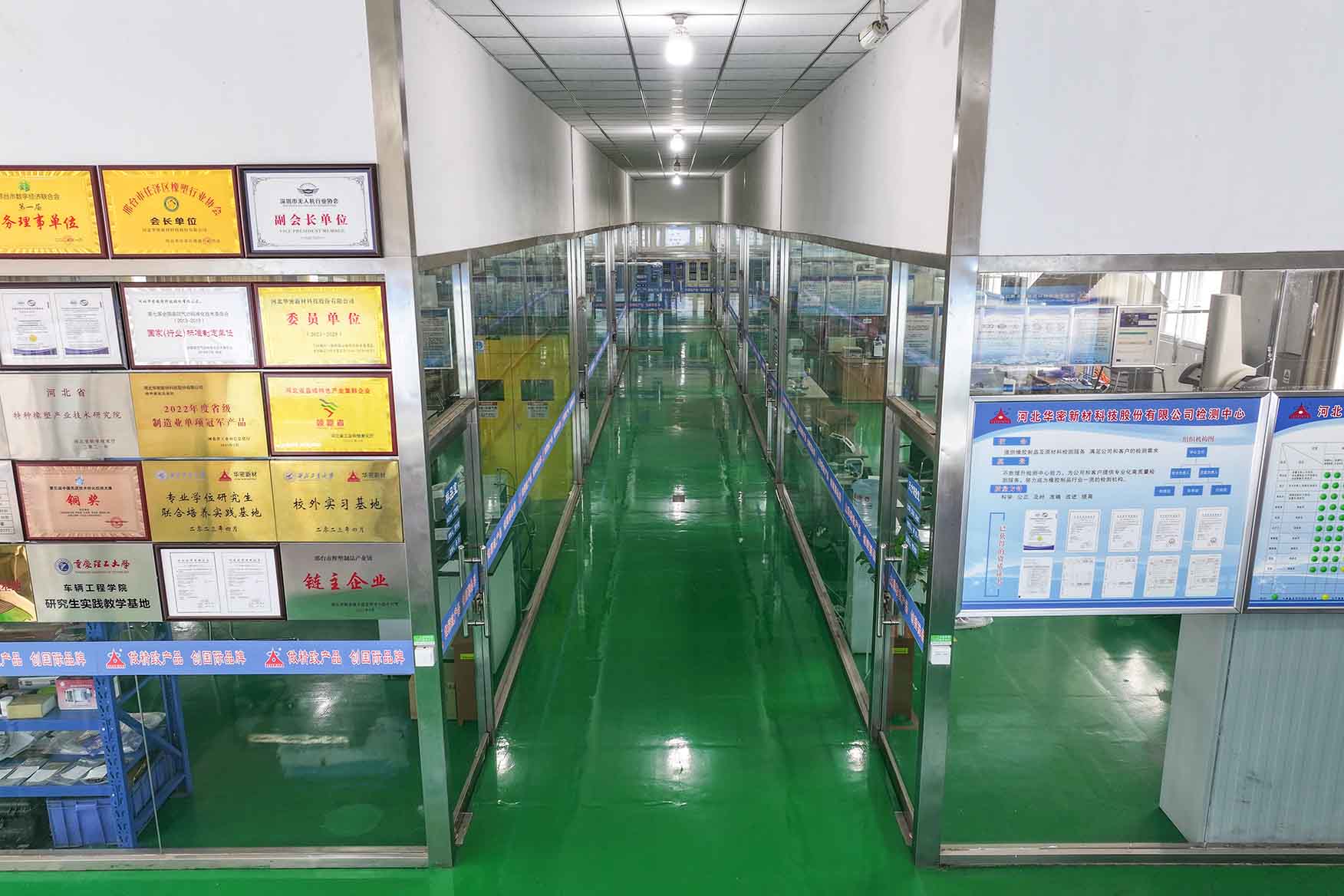
Key facts at a glance
Item | Detail |
Company | Hebei Huami New Material Technology Co., Ltd. — founded 1998, listed on the Beijing Stock Exchange in 2022 (stock code 920247) |
National status | National-level “Specialized and Sophisticated Little Giant” enterprise (awarded 2020) |
R&D platforms | Hebei Special Rubber & Plastics Industrial Technology Research Institute; Hebei Provincial Enterprise Technology Center; Hebei Key Laboratory of Special Rubber & Plastic Materials and Applications |
R&D team | 150+ technical staff — about one quarter of the total workforce |
Formulation library | 2,400+ rubber and plastic formulations developed in-house |
Testing | CNAS-accredited testing centre (since September 2021); six physical testing laboratories |
Quality systems | IATF 16949:2016, ISO 9001:2015, ISO 14001:2015, ISO 45001:2018; China Customs AEO Advanced Certified Enterprise |
Recognition | Special rubber compounds named a Hebei Province Manufacturing “Single Champion” product (4th batch) |
Engineering plastics | 12 production lines for modified special engineering plastics, designed capacity ≈35,000 t/year |
Expansion | RMB 160 million (≈USD 22 million) institute expansion: pilot-scale development base + R&D design centre |
Export channel | Hebei Tongsource International Trade Co., Ltd. (wholly-owned export subsidiary) |
Why a supplier’s research institute matters to OEM buyers
Most field failures on rubber and plastic components are not dimensional — they are material and design failures. A bushing passes first-article inspection but hardens after long exposure to heat. A seal swells in a new fuel, coolant or hydraulic fluid. A plastic bracket creeps under a hot engine cover. Drawing-to-part suppliers cannot fix these problems, because the root cause sits in the compound recipe, the part geometry or the cure process.
A supplier that owns compound formulation, structural simulation, process and tooling design, and an accredited lab can. That is the idea the institute is built around. Its team combines four disciplines — polymer materials and engineering, mechanical manufacturing and automation, engineering mechanics, and computer science — and works on a digital PLM (product lifecycle management) system. This allows us to develop new parts in parallel with an OEM’s own vehicle or machine programme and to validate each design twice: first by simulation analysis, then by physical testing — a practical digital-twin workflow.
Four capabilities under one roof
1. Compound formulation
Starting from a library of more than 2,400 formulations, our materials engineers tailor special rubber compounds — including NBR, HNBR, FKM (fluoroelastomer) and silicone — to the customer’s application and operating conditions: media, temperature, dynamic load, required hardness (Shore A) and target service life. Our special rubber compounds are recognised as a provincial “Single Champion” product, and the institute also offers compound development and related services to other manufacturers in the region.
2. Structure design and simulation
Engineering-mechanics specialists model stiffness, stress concentration and deformation before any steel is cut. For rubber-to-metal parts such as bushings, mounts and buffers, this shortens the loop between the target stiffness curve on the OEM drawing and the first sample that meets it.
3. Process and mould design
Vulcanisation parameters and mould design are developed in-house together with the compound, so that material, geometry and process are optimised as one system rather than handed from one department to the next.
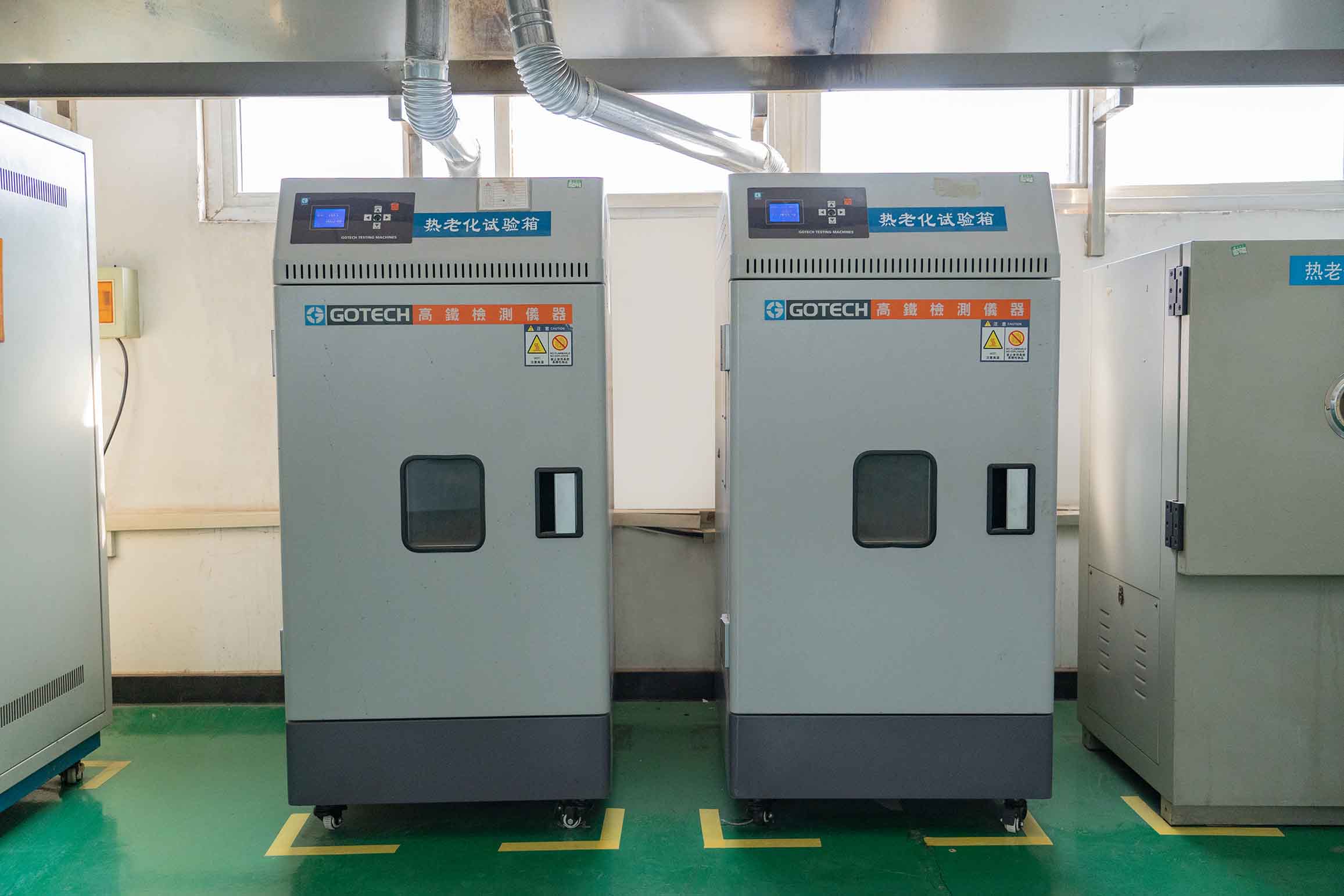
4. Testing and quality control
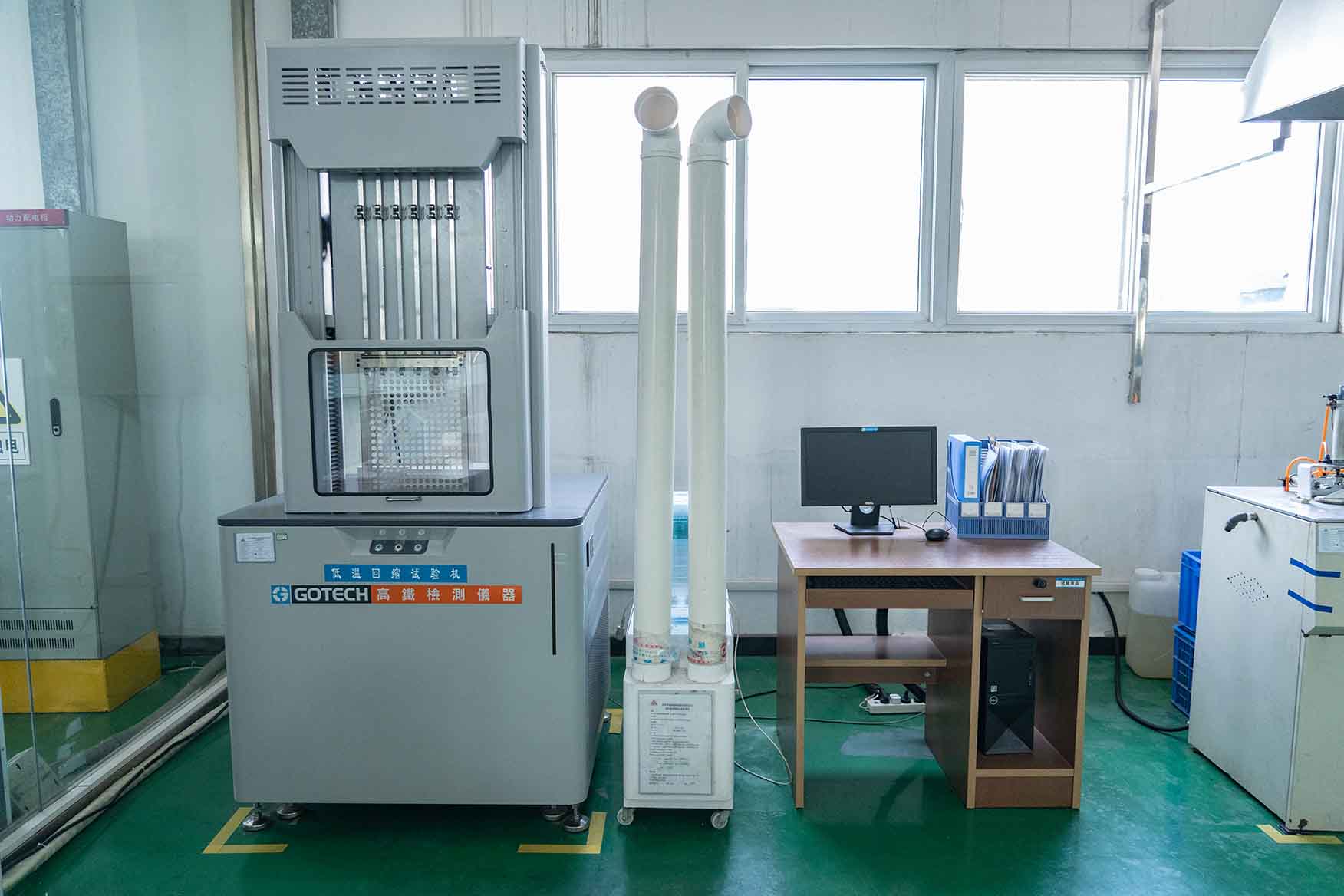
The CNAS-accredited testing centre and six physical laboratories support material development, incoming inspection and production release. A typical elastomer validation plan agreed with an OEM covers:
Property | ISO method | ASTM equivalent |
Hardness (Shore A) | ISO 48-4 | ASTM D2240 |
Tensile strength & elongation at break | ISO 37 | ASTM D412 |
Compression set | ISO 815-1 | ASTM D395 |
Heat ageing (air oven) | ISO 188 | ASTM D573 |
Fluid resistance (volume change) | ISO 1817 | ASTM D471 |
Low-temperature retraction (TR test, on a TR tester) | ISO 2921 | ASTM D1329 |
The final test matrix always follows the customer’s drawing and material specification.
Material platform: elastomers and special engineering plastics
Choosing the right polymer family is the first engineering decision on any sealing or damping part. The table below shows typical service ranges from published industry data; the limit of any specific compound depends on its formulation, and we confirm it for each project.
Elastomer (ASTM D1418) | Typical continuous service temp. | Short-term peak | Typical uses |
NBR (nitrile) | −20 °C to +100 °C | +120 °C | Oil and fuel seals, hydraulic components |
HNBR (hydrogenated nitrile) | −30 °C to +130 °C | +150 °C | Engine and driveline seals, oilfield equipment |
FKM (fluoroelastomer) | −20 °C to +200 °C | +220 °C | Fuel systems, high-temperature chemical sealing |
VMQ (silicone) | −60 °C to +160 °C | +180 °C | Low-temperature and thermal sealing, rail interior seals |
Source for temperature ranges: published elastomer temperature data (JIOrings). Values are indicative, not a specification.
On the plastics side, the institute develops modified special engineering plastics including PEEK (polyether ether ketone), PEI (polyetherimide), PPS (polyphenylene sulfide) and PI (polyimide). Reference values for the two most requested grades:
Property | PEEK (unfilled) | PEI (unfilled, e.g. ULTEM 1000) | Carbon steel (reference) |
Density | ≈1.32 g/cm³ | ≈1.27 g/cm³ | ≈7.85 g/cm³ |
Glass transition temperature (Tg) | ≈143 °C | ≈217 °C | — |
Melting point | ≈343 °C | Amorphous (no melting point) | — |
Continuous service temperature | Up to ≈250 °C (grade-dependent) | Grade-dependent | — |
Tensile strength | ≈90–100 MPa | Grade-dependent | — |
Flammability | — | UL 94 V-0 at ≥0.75 mm (resin supplier data) | — |
Generic reference values from public material data (Wikipedia/PEEK; ULTEM 1000 supplier data). Huami grade datasheets are available on request.
Engineering plastics: one-sixth the weight of steel
Huami’s special engineering plastics are already in use with CRRC and in the automotive sector. For a part of the same volume, PEEK weighs about one-sixth as much as steel (≈1.32 vs ≈7.85 g/cm³), while offering corrosion resistance, wear resistance, high specific strength and electrical insulation. Huami’s PEEK development is carried out with an institute of the Chinese Academy of Sciences, and the company has also developed a composite that replaces imported 40 % glass-fibre-reinforced PEI, as well as a self-lubricating bearing project.
Other representative products from the new polymer materials plant:
• Semiconductor chip packaging trays — a modified material with enhanced conductive and antistatic properties, developed over two years and now in volume production. For reference, ANSI/ESD S541 defines a static-dissipative material as having a surface resistance of ≥1.0 × 10⁴ Ω and <1.0 × 10⊃1;⊃1; Ω.
• Drone propeller blades — lightweight, stiff, fatigue-resistant mouldings.
• Cable clamps for wind-power high-voltage lines — insulating, weather-resistant components.
The engineering-plastics plant has 12 production lines with a designed capacity of about 35,000 tonnes per year, producing proprietary modified pellets and dedicated grades for aerospace, rail, automotive, home-appliance and electronic-packaging customers.
How co-development works with Huami
1. Share the application. Send the drawing or 3D model, operating media, temperature range, loads, target life and your material specification (for example an ASTM D2000 / SAE J200 line call-out or your in-house spec).
2. Material proposal. We select a compound from our formulation library or develop a new one, and issue a material datasheet.
3. Design and simulation. DFM feedback and FEA on stiffness, stress and deformation, using our PLM system.
4. Tooling and prototypes. In-house process and mould design; samples moulded from the proposed compound.
5. Validation. Testing against your specification in our CNAS-accredited lab, followed by your own vehicle or rig tests.
6. Series production. Production release under our IATF 16949 quality system, with the approval documentation your process requires.
Speaking your specification language
For buyers in Europe and North America, clear specification references save weeks of back-and-forth. These are the standards we most often discuss with customers:
Standard | What it covers | Why it matters in an RFQ |
ASTM D2000 / SAE J200 | Classification system for rubber materials | Defines heat and oil resistance class, hardness and test suffixes in one line call-out |
ASTM D1418 / ISO 1629 | Nomenclature for rubbers and latices | Avoids confusion between local and international material abbreviations |
ISO 3302-1 | Dimensional tolerances for moulded rubber products | Sets realistic tolerance classes on rubber drawings |
EN 45545-2 | Fire protection of materials on railway vehicles | Elastomers are rated under requirement sets such as R22/R23/R24, at hazard levels HL1–HL3 |
EN 13913 | Rail rubber suspension components — elastomer-based mechanical parts | Common reference for rail bushings, mounts and buffers |
UL 94 | Flammability of plastic materials | Standard flame rating for electrical and electronic plastic parts |
Tell us which standards apply to your part. We will confirm what test evidence exists for a given compound, or build a qualification plan to meet it.
What’s next: a RMB 160 million expansion
On the north side of Huami’s site, a RMB 160 million (≈USD 22 million) expansion of the research institute is under way. The main structure of the pilot-scale development base has been completed, and an R&D design centre is next. A new special rubber materials project is also under construction, with capacity scheduled to ramp up from 2027.
“R&D and innovation are the lifeline of the company,” says General Manager Li Cangxu. The plan is to turn the institute into an industry-leading public R&D service platform, deepen cooperation between industry, universities, research institutes and users, and focus on the materials and parts that are still hard to source.
Working with Huami from Europe or North America
International projects are handled by Hebei Tongsource International Trade Co., Ltd., Huami’s wholly-owned export subsidiary. Tongsource manages quotations, samples, export documentation and logistics, and connects your engineers directly with the institute’s material and design teams.
Have a part that keeps failing, a material that is hard to source, or a new programme that needs a development partner? Send us your drawing and specification through the contact page on tongsource.com. Our engineers will review it and propose a material and design solution.
Frequently asked questions
What is the Hebei Special Rubber & Plastics Industrial Technology Research Institute?
It is a provincial-level R&D platform operated by Hebei Huami New Material Technology Co., Ltd., approved by the Hebei Provincial Department of Science and Technology and built jointly with Qingdao University of Science and Technology, Hebei University of Science and Technology and the Hebei Academy of Sciences. It develops special rubber and plastic materials, products and processes, and carries out testing and quality-control research.
Can Huami develop a custom rubber compound to our material specification?
Yes. We start from a library of more than 2,400 rubber and plastic formulations and tailor the compound to your specification, whether that is an ASTM D2000 / SAE J200 call-out or an OEM in-house standard.
Which industries does Huami supply?
Automotive and commercial vehicles, high-speed rail, construction machinery, oil and petrochemical equipment, and electronics.
Is testing done in an accredited laboratory?
Yes. Huami’s testing centre has been accredited by CNAS (China National Accreditation Service for Conformity Assessment) since September 2021.
Which quality certifications does Huami hold?
IATF 16949:2016, ISO 9001:2015, ISO 14001:2015 and ISO 45001:2018.
Do you supply engineering-plastic components such as PEEK or PEI parts?
Yes. The institute develops modified PEEK, PEI, PPS and PI materials, and the engineering-plastics plant has 12 production lines with a designed capacity of about 35,000 tonnes per year.
How do we start a project?
Send your drawing, operating conditions and material specification via tongsource.com. Our engineers will propose a material and design solution and a sampling plan.


